Firefighting remains one of the most physically demanding and high-risk professions in public safety. Even with advances in equipment, training, and operational protocols, injuries remain a persistent challenge for departments of all sizes.
A firefighter is injured approximately every 10 minutes in the United States, and about 17% of those injuries result in lost time according to the National Fire Protection Association (NFPA). Behind each of those numbers is a firefighter, a crew, a family, and a disruption that extends far beyond a single incident. From an operational standpoint, the impact extends well beyond that individual. Injuries can lead to staffing shortages, increased overtime, and added strain on already stretched resources. But the true impact goes deeper. Careers can be disrupted. Recovery periods can be long and uncertain. In some cases, firefighters are never able to return to full duty in the same capacity.
Over time, injury patterns often reveal more systemic issues within an organization, such as:
- Different crews performing the same tasks in different ways
- Informal habits replacing standardized expectations
- Gaps between training content and real-world application
Reducing injuries, then, is actually about ensuring consistency in how work is performed so firefighters can rely on predictable, safe practices, regardless of shift, station, or assignment.
Ultimately, the goal is straightforward: Every firefighter should have the expectation of going home in the same condition they arrived. Operational effectiveness and firefighter safety are not competing priorities. They are directly connected.
With that in mind, here are six ways fire departments can reduce workplace injuries in a meaningful, sustainable way.
“A firefighter is injured approximately every 10 minutes in the United States, and about 17% of those injuries result in lost time.”
1. Standardize How High-Frequency Tasks Are Performed
Many injuries in the fire service occur during routine, high-frequency tasks rather than high-risk, low-frequency large-scale incidents. Activities such as lifting equipment, forcing entry, raising ladders, and deploying hose lines all carry inherent physical risk.
When these tasks are performed differently from crew to crew or station to station, variability increases, and so does the potential for injury.
Departments can reduce this risk by establishing clear, step-by-step policies and procedures for how these high-frequency tasks should be performed. This includes defining not just what needs to be done, but also how it should be done safely and consistently.
Equally important is reinforcement. Standardization is not achieved through a single training session. It requires ongoing repetition, reinforcement, and correction over time so expectations become habit rather than exception.
2. Build Training That Matches Real Conditions
Training environments that do not reflect operational reality can create a false sense of readiness. When firefighters train under ideal conditions, they may not be fully prepared for the complexity and stress of actual incidents.
Effective training should incorporate the conditions firefighters are likely to face in the field, including:
- Full personal protective equipment (PPE)
- Time constraints and urgency
- Low-visibility environments
- Physical fatigue and exertion
Just as importantly, training should focus on decision-making, not just task completion. Fireground performance often depends on the ability to assess evolving conditions and adjust accordingly under pressure.
Reinforcement should also be ongoing. Skills that are not regularly practiced under realistic conditions can degrade over time, increasing the likelihood of injury during real-world operations.
3. Make Policies Easy to Access and Apply in the Moment
Even well-written policies and procedures can lose effectiveness if they are not accessible when they are needed most.
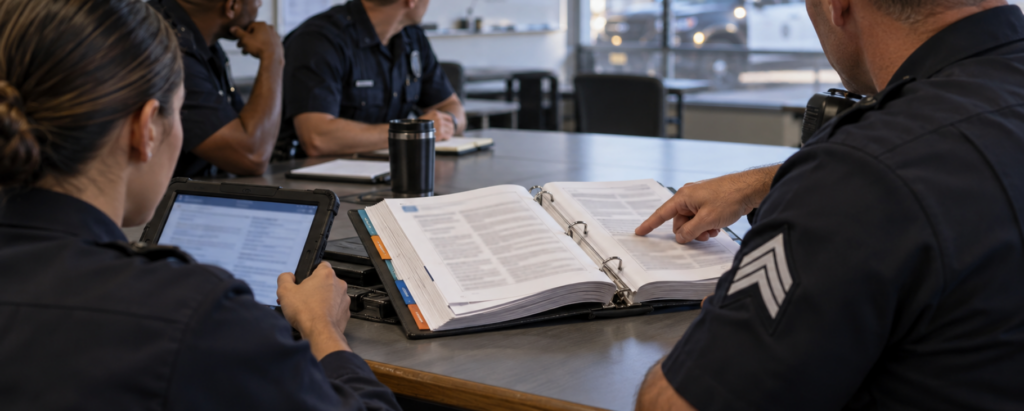
Firefighters operate in fast-moving, high-pressure environments where decisions must be made quickly. If policies are buried in paper-based binders, outdated systems, or difficult-to-navigate platforms, they are far less likely to influence behavior in real time.
Departments can improve compliance and safety outcomes by ensuring policies are easy to access during a shift, reinforced during briefings and training exercises, and written in clear, concise, operational language.
Policies should not exist as static documents. They should function as practical tools that support decision-making on the fireground and in day-to-day operations. And of course, when policies are changed or updated, appropriate communication and training should reinforce those changes.
4. Address Fatigue and Dehydration as Safety Factors
Fatigue is widely recognized as a contributing factor in firefighter injuries. However, hydration is often less emphasized, despite its significant role in both physical performance and injury risk.
Dehydration acts as a risk multiplier in the fire service. It can increase susceptibility to heat-related illness, particularly during training exercises and summer operations. It also contributes to cardiovascular strain during physically demanding tasks.
This is especially important given that cardiac events remain the leading cause of line-of-duty deaths in the fire service. Dehydration, combined with heat stress and exertion, can significantly elevate that risk.
Departments can address this by:
- Reinforcing hydration protocols before, during, and after incidents and training.
- Treating hydration as an operational readiness factor, not just a wellness consideration
- Incorporating rehab, cooling, and rehydration practices into standard operating procedures.
- Encouraging crews to assess physical readiness—including hydration status—before engaging in strenuous tasks.
When fatigue and hydration are addressed together, departments are better positioned to reduce preventable injuries linked to both heat stress and cardiovascular strain.
RELATED: Firefighter Safety in Hot Water
5. Strengthen Accountability and Documentation
Consistency in safety practices depends on accountability. Without clear documentation and tracking, it becomes difficult to ensure training, policies, and expectations are being applied uniformly across an organization.
Departments can strengthen accountability by tracking training completion and participation, documenting policy updates and distribution, and ensuring expectations are consistently communicated across all levels of the organization.
This isn’t just an administrative exercise. It creates visibility into whether standards are actually being followed in day-to-day operations. Without that visibility, gaps in practice can go unnoticed until an injury occurs.
6. Identify Patterns and Adjust Before Injuries Happen
In many cases, firefighter injuries are not random. Patterns often emerge over time, whether related to specific tasks, shifts, environmental conditions, or operational contexts.
Departments that actively track and analyze injury data are better positioned to identify these patterns early. Key areas to evaluate include:
- Where injuries are occurring
- What tasks are most frequently involved
- Whether certain shifts or conditions show higher risk
- Recurring contributing factors
This information should be used proactively, not reactively. When trends are identified early, departments can adjust training, reinforce procedures, or address underlying operational issues before additional injuries occur.
RELATED WEBINAR: The Cost of Firefighter Injuries: Reducing Fiscal & Physical Impact
Turning Standards Into Safety
Reducing workplace injuries in the fire service doesn’t come down to a single policy, a training session, or a reminder to be careful. It comes down to how consistently expectations are set, reinforced, and followed every day, across every shift.
Most departments already have at least some of the pieces in place. The difference comes from how those pieces are used. When training reflects real conditions, when policies are applied in the moment, and when safe practices become the standard—not the exception—you start to see fewer preventable injuries.
Because at the end of the day, this isn’t just about statistics or operational impact. It’s about making sure every firefighter who walks into the station has a better chance of going home safe. That’s the standard worth working toward.
See how fire departments are strengthening consistency, improving training outcomes, and reducing organizational risk with integrated policy and training solutions from Lexipol. BOOK 15 MINS today.
- Blog Articles